
Markets in Transition
Commentary by Edward Miller, CFA, CMT | Chief Investment Officer
I’m writing this letter a few days after the US and Israel jointly attacked Iran. In that brief time, the S&P 500 has been volatile, but currently the Index remains more or less flat. In fact, since the end of October 2025, the S&P 500 has earned a paltry +1% return. In comparison, the equal-weight S&P 500 has gained nearly 9% in that same time period, indicating that the mega-cap members of the Index have been struggling to maintain their leadership position. The once-high-flying “Magnificent 7” stocks have actually posted a negative return YTD, losing -7% as a group through the end of February compared to the S&P 500’s +0.5% return in that time.
It’s apparent that even before this military event with Iran, equity markets have been transitioning, with investors gradually shifting positions away from risk-on sectors to more risk-off or defensive areas. For example, the consumer staples sector[1],[2] is up +15.9% and the utilities sector1,[3] has returned +11.8% YTD through February. Compare those returns with a classic risk-on sector, technology1,[4], which is down -3.6% YTD. Also, after underperforming the S&P 500 for the last few years, health care stocks1,[5] have seemingly found their footing, gaining +11.5% since the start of last November, handily surpassing the S&P 500’s meager +0.9% return in that time.
Why this recent transition from risk-on to risk-off? As is often the case when it comes to deciphering movements in markets, the answer(s) usually becomes evident weeks or months later. Equities tend to discount the future with investors constantly pricing and re-pricing expectations about the days, weeks and months ahead. When new information appears and is deemed relevant and impactful, it often almost immediately gets “baked in” to stock prices. That said, what can significantly change stock prices is unanticipated news or information that was not already discounted in current stock prices.
It can be argued that what’s driving the movement into safer asset classes relates to a fairly recent shift from what can be described as “AI euphoria” to more of a skeptical view that increasingly wants to see real-life examples of productivity improvements, as opposed to just promises. It’s this change in AI sentiment that is likely adversely impacting the “Magnificent 7” stocks. Another mounting anxiety investors have about AI companies involves the enormous amounts of capital being committed to this space and whether or not such massive investment will in time translate into likewise massive rewards.[LW1]
On the topic of discounting the future and given the start of what’s being called Operation Epic Fury (Iran attack), we thought it might be worthwhile to explore how US equities have performed during times of military events.
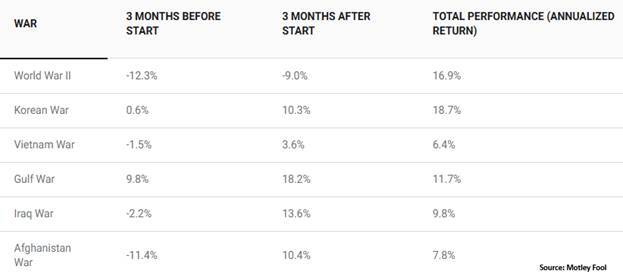
The graphic shown above lists major US wars dating back to WWII, along with respective S&P 500 returns for three months pre-war, three months post-war, and annualized total return for the entire war duration. In general, stock prices tend to be relatively weak before a war starts, as investors likely discount worst-case scenarios during the lead-up phase. But after war starts, stocks tend to do well in the several weeks to follow, likely due to a tempering of concerns by investors, who perhaps look at the prior months of market weakness as a buying opportunity. Note also that the total returns generated during the wars are all positive and the average annualized total return for the six wars is 11.8%, which is above the 10.5% annualized total return for the S&P 500 since 1925.
Admittedly, it’s a bit surprising to learn that the stock market fares quite well during periods of war. Reasons for this bullish tendency can be numerous, with a major one being the federal government significantly increases fiscal spending, which stimulates the entire domestic economy. Also, there is much truth to the Wall Street axiom, “Bull markets climb a wall of worry” – and certainly during war it’s a time of ample worry!
I would add that what is not shown in the graphic above is just how volatile stock prices can be during military events. Although all the annualized total returns in the above graphic are positive, these periods of war could’ve included some extreme bouts of volatility along the way. As an example, the following chart shows the S&P 500 for the period of US involvement in the Vietnam War.
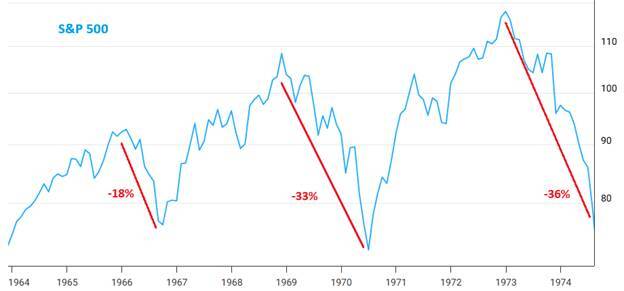
Although it can be debated the exact dates for the start of US presence in the war, as well as an end, the above chart shows how the S&P 500 performed from 1964 to 1974. Needless to say, volatility was elevated for the entire period, as impressive rallies were followed by painful declines.
We’re not necessarily suggesting or guessing that the current military event with Iran will result in stock price action replicating the above chart. However, given the many unknowns that come with any military event, it’s financially prudent to prepare for what could result in a meaningful stock price variability.
As always, if you have any questions, please feel free to call or email.
The entire team at Measured Wealth wishes to thank you for entrusting us to deliver on your financial goals.
Edward Miller, CFA, CMT
Chief Investment Officer
Measured Wealth Private Client Group
Important Disclosures
Historical data is not a guarantee that any of the events described will occur or that any strategy will be successful. Past performance is not indicative of future results.
Returns citied above are from various sources including Factset, Bloomberg, Russell Associates, S&P Dow Jones, MSCI Inc., The St. Louis Federal Reserve and Y-Charts, Inc. The content is developed from sources believed to be providing accurate information. The information in this material is not intended as tax or legal advice. Please consult legal or tax professionals for specific information regarding your individual situation. The opinions expressed and material provided are for general information and should not be considered a solicitation for the purchase or sale of any security. Investing involves risks, including possible loss of principal. Please consider the investment objectives, risks, charges, and expenses of any security carefully before investing.
This publication is provided to clients and prospective clients of Measured Wealth Private Client Group, LLC for general informational and educational purposes only. It does not: (i) consider any person's individual needs, objectives, or circumstances; (ii) contain a recommendation, offer, or solicitation to buy or sell securities, or to enter into an agreement for investment advisory services; or (iii) constitute investment advice on which any person should or may rely. Past performance is no indication of future investment results. This publication is based on information obtained from third parties. While Measured Wealth Private Client Group, LLC seeks information from sources it believes to be reliable, Measured Wealth Private Client Group, LLC has not verified, and cannot guarantee the accuracy, timeliness, or completeness, of the third-party information used in preparing this publication. The third-party information and this publication are provided on an “as is” basis without warranty.
This publication may contain forward-looking statements relating to the objectives, opportunities, and the future performance of the U.S. market generally. Forward-looking statements may be identified by the use of such words as; “should,” “estimated,” “potential” and other similar terms. Examples of forward-looking statements include, but are not limited to, estimates with respect to financial condition, results of operations, and success or lack of success of any particular investment strategy. All are subject to various factors, including, but not limited to general and local economic conditions, changing levels of competition within certain industries and markets, changes in interest rates, changes in legislation or regulation, and other economic, competitive, governmental, regulatory and technological factors affecting a portfolio's operations that could cause actual results to differ materially from projected results. Such statements are forward-looking in nature and involve a number of known and unknown risks, uncertainties and other factors, and accordingly, actual results may differ materially from those reflected or contemplated in such forward-looking statements. Prospective investors are cautioned not to place undue reliance on any forward-looking statements or examples. None of Measured Wealth Private Client Group, LLC or any of its affiliates or principals nor any other individual or entity assumes any obligation to update any forward-looking statements as a result of new information, subsequent events or any other circumstances. All statements made herein speak only as of the date that they were made.
Magnificent 7’ is a market term and is being used for illustrative purposes only. The individual securities and related returns shown are presented solely for illustrative and informational purposes to demonstrate recent market trends. They are not intended to represent holdings in any Measured Wealth portfolio, nor do they represent investment recommendations or past or current performance of any Measured Wealth strategy. Measured Wealth may or may not hold any of the securities discussed.”
In order to provide effective management of your account, it is important that we have current information regarding your financial status and circumstances. Please contact us in writing at 303 Islington Street, Portsmouth, NH 03801 if you have any changes in your financial situation or investment objectives, and whether you wish to impose any reasonable restrictions on the management of the account or reasonably modify existing restrictions.
Measured Wealth Private Client Group, LLC is an investment adviser located in Portsmouth, New Hampshire. Measured Wealth Private Client Group, LLC is registered with the Securities and Exchange Commission (SEC). Registration of an investment adviser does not imply any specific level of skill or training and does not constitute an endorsement of the firm by the Commission. Measured Wealth Private Client Group, LLC only transacts business in states in which it is properly registered or is excluded or exempted from registration.
[1] See disclosures. Informational only; not a recommendation to buy or sell securities.
[2] ETF ticker: XLP
[3] ETF ticker: XLU
[4] ETF ticker: XLK
[5] ETF ticker: XLV