Investment Perspective
“
Market prices reflect investor's expectations, but they cannot tell us with certainty what comes next.
The midterm elections are behind us. Democrats won decisively in what many are calling a “blue tsunami,” and stocks rallied strongly the day after the vote. As I write this letter, however, the market is reversing sharply, with most major indices down 3% to 5% so far today. The selling is concentrated in companies tied closely to artificial intelligence (AI). Semiconductor and data-center stocks have fallen the hardest, while a rise in oil prices has added pressure to the broader market.
By most accounts, we believe the catalyst is the political shift that followed Tuesday’s elections. Democrats flipped both chambers of Congress and several key governorships, including Texas. According to the analysis we have been reading, Texas’s incoming governor has promised an “immediate” data-center moratorium in 2027, and local ballot measures on data centers have broadly favored restricting further development. That matters because hyperscaler AI spending is expected to exceed $1 trillion through fiscal 2027, and investors are now asking whether the buildout could slow enough to hurt the broader U.S. economy.
The concern also extends well beyond chip companies. AI spending supports a long chain of businesses, including utilities, gas turbine makers, pipelines, renewable and storage providers, and construction firms. It has also been a major engine of U.S. growth: third-quarter GDP rose 3.2%, led by business investment in AI-related equipment. When investors worry that this spending may slow, the effects ripple across the entire market.
Some commentators argue that the election result makes a recession in 2027 more likely. In their view, AI spending will fall sharply, while inflation, which has outpaced wage growth since 2020, can only be brought under control by a slowdown. We take that bearish scenario seriously, but it rests on a long chain of assumptions, and there are facts that potentially cut against it. First, while the margin of victory may have been more lopsided than expected, Congress changing hands was not wholly unexpected, and stocks had been moving sideways or giving back gains in the months leading up to the election. Second, the new Congress will not be sworn in until January, and most 2027 AI spending commitments will likely be finalized before then. The bigger unknown is 2028.
It is also worth remembering that declines of 10% or more are a regular feature of long-term investing, not necessarily a sign that something is permanently broken. Needless to say, significant pullbacks are uncomfortable, but they are also how markets reprice risk and create opportunities for patient investors. We expect volatility to remain elevated over the coming weeks and months as the policy picture comes into focus.
Markets Reflect Expectations, Not Certainty
The stock market is sending a message worth hearing, though not necessarily an alarming one. Until this recent abrupt retreat, most major indices were at or near record highs just prior to elections, which suggests that investors’ concerns were less severe than the headlines implied. It helps to remember that the market is not a mirror of today’s news. It is a forward-looking mechanism that prices in what investors expect to happen long before it shows up in earnings reports, economic data, or the evening news. While nothing is perfect, in our experience the market does a very good job of assessing the future today.
The idea behind the market’s ability to anticipate the future is often called “the wisdom of crowds,” a phrase popularized by author James Surowiecki in his 2004 book of the same name, The Wisdom of Crowds. Surowiecki describes how the collective judgment of a large, diverse group of independent individuals is often more accurate than the estimate of any single expert in the group. Applied to financial markets, the stock market works as an aggregation engine. Millions of investors independently weigh information and express their views through trades, and the resulting price distills or synthesizes countless fragments of private knowledge into today’s prices, “discounting” expectations about the future.
The television game show “Who Wants to Be a Millionaire?” offers an illustration of the power of this collective wisdom. On the show, contestants could “Ask the Audience” for help with a question, and over decades of broadcasts, including international versions, the audience’s most popular answer was correct roughly 91% to 95% of the time. No single audience member needed to be an expert. Taken together, the crowd was usually right.
There are countless examples like these in finance, but one stands out to us: the 2007–2009 period. As the following chart shows, the S&P 500 peaked in late 2007, and its long-running uptrend line (shown in gold) broke around the turn of the year, well before the most severe economic and financial stress of 2008.
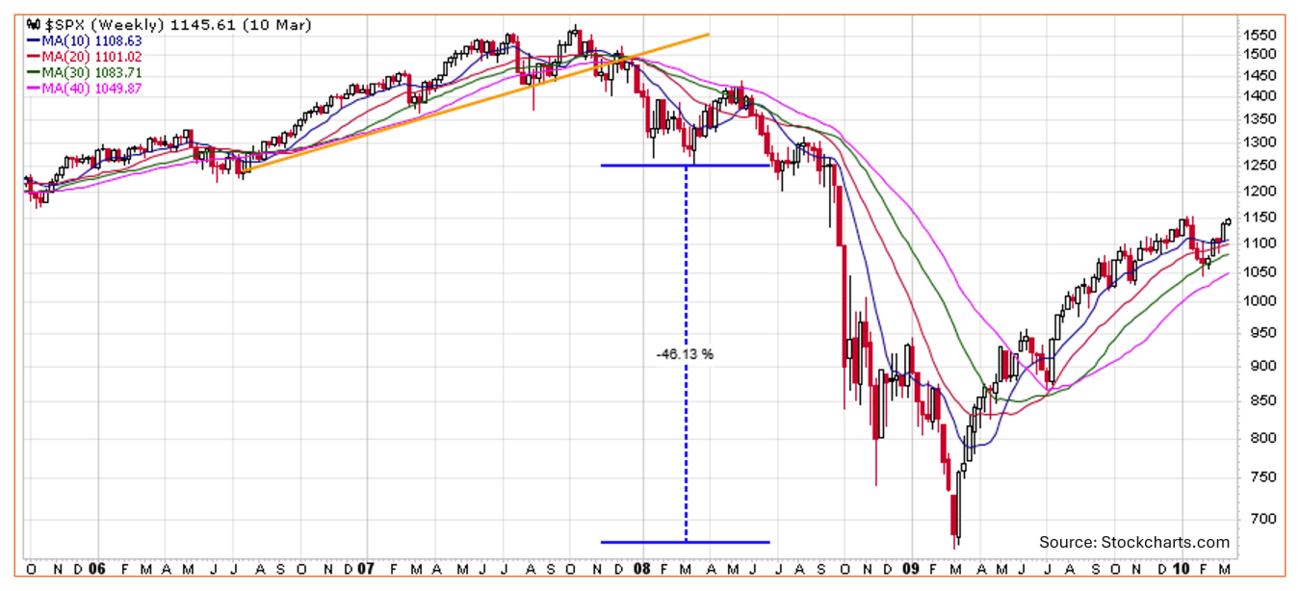
S&P 500 Index ($SPX), weekly, 2006–2010. The long-running uptrend line (gold) broke near the start of 2008, well before the worst of the crisis; the index fell about 46% to its March 2009 low. Source: StockCharts.com.
In early 2008, the S&P 500 continued to drift lower, staying below several key moving averages that served as further warnings of trouble ahead. The index went on to fall another 46% from its early-2008 level to the March 2009 low. Notice also that the recovery began while conditions still felt grim. Prices bottomed and turned higher in the spring of 2009, well before it became clear that the global financial system would not collapse.
Markets topped when the economy still looked fine, and they bottomed when it looked its worst. That is what it means to discount the future, and we have found over time that it pays to heed the messages markets send.
The November 2016 presidential election provides another example. The following chart of the S&P 500 covers 2016 and 2017.
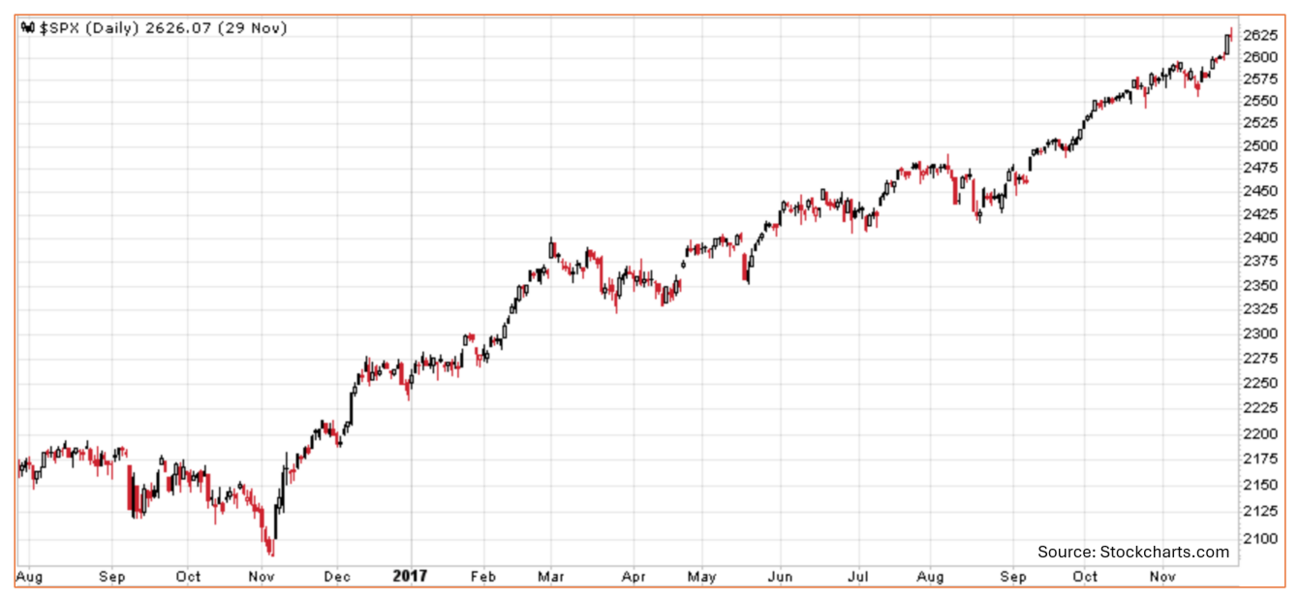
S&P 500 Index ($SPX), daily, 2016–2017. After the November 2016 election the index rose from near 2,090 to roughly 2,625 within about a year. Source: StockCharts.com.
In the lead-up to the 2016 election, many experts warned of a significant market decline if Donald Trump won. Instead, the S&P 500 rose from a low near 2,090 to roughly 2,625 within about a year, a gain of about 25%. Investors, “the crowd,” had weighed the evidence and looked past the predictions of individual experts.
One could argue that the same pattern has played out over the last few years. Many tried-and-true indicators have flashed bearish warning signs, yet the stock market looked past them, rising steadily and setting new highs. At least officially, the economy has not entered a recession, so once again the market appears to have been right about the future.
It’s safe to say that if we were in end-of-days, cataclysmic times, stock prices would already be far lower. Instead, until recently, stocks were hovering near record highs pre-elections, the opposite of what the market did ahead of 2008. That is not to say conditions cannot change dramatically in the coming weeks or months. But if they do, we will respect the message(s) the market is sending us.
We wish to emphasize that markets are not never-wrong crystal balls. They discount what can be known or reasonably expected, and yet they typically fail to anticipate a genuine surprise, such as a sudden geopolitical event or an unforeseen shock. When one arrives, prices adjust quickly and sometimes painfully. We cannot rule that out; no one can. Today’s painful selloff is also a reminder that markets can overreact in the short term, especially when a new and uncertain policy development meets a crowded trade. Prices are valuable clues about the near future, but they are not a guarantee.
That is why we build your portfolio around your goals, time horizon, and tolerance for risk rather than around any single forecast. Staying diversified, maintaining adequate liquidity, and following a plan rather than reacting to emotion have served investors well through every cycle, including the difficult ones.
Please do not hesitate to reach out if today’s volatility has raised questions or concerns about your own situation. We are always glad to talk.
Thank you for your continued confidence.
Important Disclosures
Measured Wealth Private Client Group, LLC ("Measured Wealth") is an investment adviser located in Rye, New Hampshire, registered with the SEC. Registration does not imply a certain level of skill or training.
This publication is provided to clients and prospective clients for general informational and educational purposes only. It does not consider any person's individual needs or circumstances and is not investment, tax, or legal advice, or a recommendation, offer, or solicitation to buy or sell any security or to enter into an advisory agreement. Please consult your tax or legal professional regarding your individual situation.
Individual securities, indices, and exchange-traded funds, and their returns, are shown for illustrative purposes only, to demonstrate recent market trends. They are not presented as Measured Wealth portfolio holdings or recommendations, and do not represent the past or current performance of any Measured Wealth strategy. Measured Wealth clients may hold positions in securities discussed, and Measured Wealth may buy or sell them at any time. Indices are unmanaged and cannot be invested in directly.
Data is drawn from third-party sources, including FactSet, Bloomberg, Russell, S&P Dow Jones Indices, MSCI, the Federal Reserve Bank of St. Louis, and YCharts, that Measured Wealth believes to be reliable but has not independently verified and cannot guarantee as to accuracy, timeliness, or completeness.
Investing involves risk, including possible loss of principal. Past performance and historical data do not guarantee future results or that any strategy will be successful.
This commentary contains forward-looking statements, including views on markets, economic conditions, and investment strategies. These statements reflect our judgment as of the date of publication, are subject to change without notice, and involve known and unknown risks and uncertainties, including changes in economic conditions, interest rates, and regulation, that could cause actual results to differ materially. Readers should not place undue reliance on them. Measured Wealth undertakes no obligation to update any forward-looking statement.
Please contact us if there have been any changes in your financial situation or investment objectives, or if you wish to impose any reasonable restrictions on the management of your account or reasonably modify existing restrictions.